
Introduction
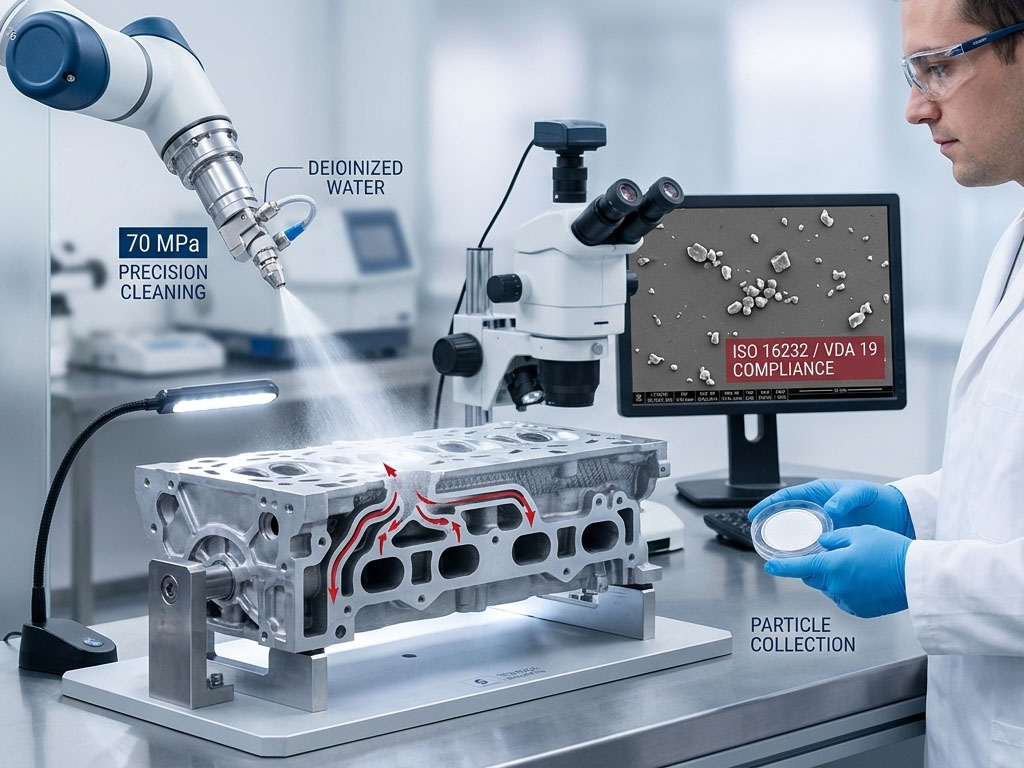
In modern automotive manufacturing, cleanliness is no longer a “bonus”—it is a critical functional requirement. As engines and hydraulic systems become more compact and sophisticated, even a microscopic particle can lead to catastrophic failure. This has made ISO 16232 and VDA 19 the “Golden Standards” for technical cleanliness worldwide.
Why These Standards Matter
ISO 16232 (International) and VDA 19 (German) provide a standardized framework for:
- Extraction: How to properly wash a part to collect contaminants.
- Analysis: Determining the size, type, and quantity of particles.
- Validation: Setting clear “Pass/Fail” limits for mass and particle length.
For Tier 1 and Tier 2 suppliers, compliance isn’t just about passing an audit; it’s about ensuring the long-term reliability of power steering units, fuel injection systems, and braking components.
The Challenge: Reaching “Technical Cleanliness”
Traditional ultrasonic or low-pressure immersion washing often hits a ceiling when trying to meet these strict codes. Complex geometries, such as intersecting oil galleries and blind holes, are notorious hiding spots for metallic chips and carbon residues that standard methods simply cannot dislodge.
SEPARATECH Insights: Why 70 MPa is the Answer
To meet and exceed ISO 16232 requirements, the industry is shifting toward High-Pressure Water Jet Deburring (HPWJD).
At SEPARATECH, our SC Series Jet Clean Centers are engineered specifically for this mission:
- Targeted Precision: Our CNC-controlled nozzles focus 70 MPa of pressure directly into critical internal channels.
- Complete Particle Removal: The kinetic energy of the high-pressure jet ensures that even the most stubborn “hanging burrs” are removed, which is essential for VDA 19 compliance.
- Repeatability: Automation ensures that every part is cleaned with the exact same pressure, angle, and time—eliminating human error from your quality assurance process.
Conclusion: Future-Proofing Your Supply Chain
As the automotive world moves toward Electric Vehicles (EVs) with even more sensitive cooling and battery systems, technical cleanliness will only become more rigorous. By adopting 70 MPa cleaning technology today, you aren’t just meeting a standard—you are future-proofing your production line.
Would you like to know more? Get in touch with us or write to us!
Are you interested in our machines and systems?